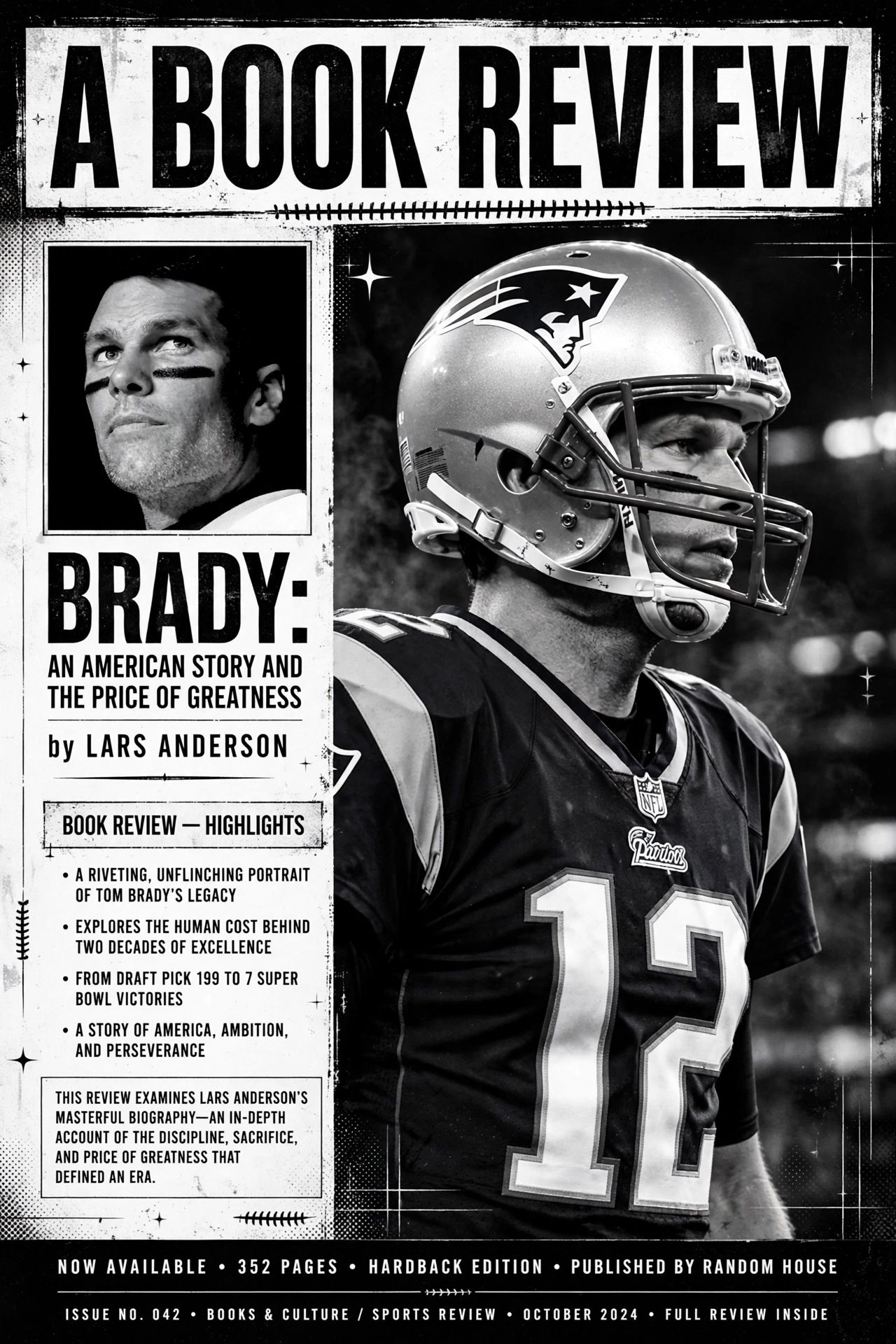
The Unbearable Toll of Being the GOAT: A Review of Lars Anderson’s “Brady: An American Story and the Price of Greatness”


For two decades, Tom Brady was the most visible and yet most opaque figure in American sports. We watched him hoist seven Lombardi Trophies, saw him defy age and logic, and witnessed the slow-motion unraveling of his marriage to the most famous supermodel on earth. But the man behind the helmet—the engine that drove that relentless pursuit, the quiet torment that accompanied every victory—remained largely hidden behind carefully curated press conferences and a famously guarded personal life.
Lars Anderson, the New York Times bestselling author and former Sports Illustrated journalist, has done what no other writer has managed. In Brady: An American Story and the Price of Greatness, he has delivered the definitive biography—a work of such depth and psychological acuity that it transforms one of sports’ most familiar success stories into something far more complex, and far more unsettling .
───
The Architect of the Book
Before examining the book itself, it is worth understanding the architect behind it. Anderson is no ordinary sports journalist. He spent twenty years at Sports Illustrated, writing more than two dozen cover stories for a readership of over twenty-two million. He is the author of twelve books, five of which have been optioned for movies, including The Mannings and The Storm and the Tide . In 2025, the University of Alabama honored him with the Clarence E. Cason Award in Nonfiction Writing—the school’s top literary honor, previously given to twenty-six Pulitzer Prize winners .
But Anderson’s greatest asset in undertaking this project is his understanding of the genre. A biography of a living icon requires a delicate balance: access without hagiography, intimacy without intrusion, and critical distance without cynicism. Anderson understood this implicitly. “Numerous books have been written about different aspects of Tom Brady’s career,” he told People magazine, “but no one has authored the definitive biography on him: a meaty, deeply reported narrative that gives readers a 360-degree view of his iconic life” .
His methodology was painstaking. Over 350 original interviews with people who knew Brady on and off the field—teammates, coaches, family members, friends—form the bedrock of this narrative . Anderson spent two years “digging into the bedrocks of Brady,” as he put it, with a clear mission: to “humanize” the quarterback beyond the headlines, to “explain what he represents, what makes him tick, and why he inspires so much passion” .
───
The Architecture of Greatness
Brady: An American Story and the Price of Greatness opens not with a Super Bowl victory or a draft-day memory, but with a scene that sets the tone for everything that follows: a blind date in New York’s West Village with a young supermodel named Gisele Bündchen . It is a quietly devastating choice. In that opening chapter, Anderson establishes that this biography will be as much about the costs of Brady’s obsession as it is about his triumphs.
From there, Anderson plunges back into Brady’s childhood in San Mateo, California, where the seeds of what Brady himself would later describe as his “sickness” were first planted. The quarterback grew up trailing three accomplished older sisters and idolizing Joe Montana—the first model of quarterbacking excellence, and the first measuring stick against which Brady would compare himself . Anderson traces how this early environment, filled with competition and high expectations, forged a young man who could never feel that he had done enough.
The book’s treatment of Brady’s college years is revelatory. When Brady arrived at the University of Michigan, he was the seventh-string quarterback—an afterthought, a practice body. One scout at the NFL Combine would later report: “Poor build, skinny, lacks great physical stature and strength, lacks mobility and ability to avoid the rush” . This became the fuel for a fire that would burn for over two decades. Anderson shows how Brady learned to fight for playing time, developing the resilience and political savvy that would later serve him in the Patriots’ locker room .
The 2000 NFL Draft is treated with appropriate gravity. Selected with the 199th overall pick—the seventh quarterback taken that year—Brady arrived in New England as such an improbable prospect that one veteran player “didn’t think in 8 million years” Brady would even make the team . This, of course, became the foundation of his origin mythology: the overlooked kid who became the greatest of all time.
───
The Contradictions Within
What elevates this biography above the standard sports hagiography is Anderson’s willingness to sit with the contradictions. Brady, he finds, is “a self-described loner” whose life is defined by “discipline, resilience, a fascination with preparation, an intolerance for wasted time, and a relentless pursuit of the extraordinary” . But this same drive made him, in the words of the author, a “man riddled with contradiction” .
Consider Brady’s own words, quoted in the book: “If you compete against me, you better be willing to give up your life, because I’m giving up mine” . This is a stunning confession, a glimpse into the psychological machinery of a champion who could never switch off the engine of competition. But it is also an admission of a life unbalanced.
Anderson dedicates significant attention to Brady’s relationship with Bündchen, who described football as his “first love” . Their marriage ended after thirteen years, not because of infidelity or financial strain, but because Brady refused to step away from the sport. “He chose football over family,” one source told Anderson, and the biography does not flinch from the devastation that choice wrought. Brady himself admitted he feared passing his competitiveness on to his kids, saying: “There’s a torment about me I don’t wish upon them” .
One of the book’s most affecting threads is Anderson’s examination of Brady’s role as a father. The quarterback’s obsession dictated how he managed his day-to-day schedule, including his availability to his three children . The biography suggests that Brady was often physically present but emotionally distant—a man so consumed by preparation that he could not fully inhabit his role as a parent.
This is not a book that delights in scandal or seeks to tear down a legend. Anderson’s admiration for Brady’s accomplishments is genuine, even as he refuses to gloss over the costs. “What he finds,” reads the publisher’s synopsis, “is a man riddled with contradiction, defined by both a prolific career of unmatched success on the field and the agonizing cost of greatness in his personal life” .
───
A Psychological Portrait
Anderson’s background as a journalist who has written extensively about the psychology of athletes is evident throughout. He approaches Brady not as a collection of statistics or a parade of highlights, but as a case study in what happens when human ambition meets its outer limits.
The term “category-five obsession” recurs throughout the book, and for good reason . Brady’s relationship with football was not a passion—it was a compulsion. The obsession dictated everything: what foods he ate, how he managed his day-to-day schedule, how he viewed his role as father and husband . It was, as Brady himself confessed, a sickness—a word that connotes pathology rather than virtue.
This framework allows Anderson to ask a question that other biographers have avoided: Was it worth it? The book does not offer an easy answer. On one level, of course, the answer is yes. Brady won seven Super Bowls, set virtually every passing record, and earned over $300 million. But on another level—the level of personal fulfillment, of family relationships, of emotional health—the answer is far more ambiguous.
Anderson treats the question with the seriousness it deserves. He does not romanticize Brady’s sacrifice; he examines it, catalogues it, and asks the reader to sit with its weight. The book’s subtitle—”An American Story and the Price of Greatness”—is an honest descriptor. This is a story about achievement, yes, but it is also a story about what achievement costs, and about the kind of person willing to pay that price.
───
Narrative Craft
Anderson’s prose is lean and muscular, befitting a writer who spent two decades at the most celebrated sports magazine in American history. But what distinguishes Brady from the typical sports biography is its cinematic quality. Anderson employs what he calls “put-you-there storytelling techniques,” aiming “to place the reader next to Brady at all the key moments of his life, recreating scenes to show sides never before seen of the winningest player in NFL history” .
This is not easy to execute. Recreating scenes from a subject’s life requires a combination of reportorial rigor and narrative imagination—the ability to synthesize hundreds of interviews into coherent, emotionally resonant moments. Anderson succeeds. Whether he is describing Brady’s first encounter with Bill Belichick, his reaction to being drafted in the sixth round, or the quiet tension in his household as retirement loomed, the scenes feel lived-in and true.
The book’s 432 pages fly by, a testament to Anderson’s pacing and his ability to find dramatic weight in both the grand moments and the small details . The reader is not merely told that Brady was driven—they are shown the evidence, scene by scene, until the portrait accumulates the density of a life fully lived.
───
The Bigger Question
At its heart, Brady: An American Story and the Price of Greatness is not a book about football. It is a book about the nature of ambition, the psychology of achievement, and the human cost of chasing greatness. Anderson has written a biography that will appeal not only to football fans but to anyone who has ever wondered what it takes to be the best—and what happens after.
“Who, really, is Tom Brady?” the book’s synopsis asks . After reading Anderson’s masterful portrait, the answer feels both clearer and more elusive. He was the greatest quarterback in NFL history. He was a father who often chose the film room over the dinner table. He was a teammate who inspired profound loyalty and demanded extraordinary sacrifice. He was a man who conquered nearly every opponent except his own appetite for victory .
This is the great achievement of Anderson’s book: it does not resolve the contradictions—it holds them in tension. Brady remains a figure of fascination precisely because he cannot be reduced to a single narrative. He was both a champion and a man who sacrificed too much; a leader and a loner; an icon and a cautionary tale.
In the end, Brady: An American Story and the Price of Greatness is an essential read—not because it provides the final word on Tom Brady, but because it refuses to pretend that such a final word exists. It is a biography that respects its subject’s complexity, and by doing so, it respects the reader’s intelligence.
───
About the Book
Title: Brady: An American Story and the Price of Greatness
Author: Lars Anderson
Publisher: Celadon Books (Macmillan)
Publication Date: September 29, 2026

Page Count: 432 pages
Format: Hardcover, eBook, Audiobook (narrated by Max Meyers)
ISBN: 978-1-250-36030-4
Price: $32.99 (Hardcover)
Where to Find It: Available for pre-order at all major booksellers, including:
· Barnes & Noble (barnesandnoble.com)
· Bookshop.org (supporting independent bookstores)
· Amazon (amazon.com)
· Audible (audiobook version)
· Apple Books (eBook and audiobook)
· Google Play Books
· Readings (Australian edition)
───


Leave a Reply